Context and importance
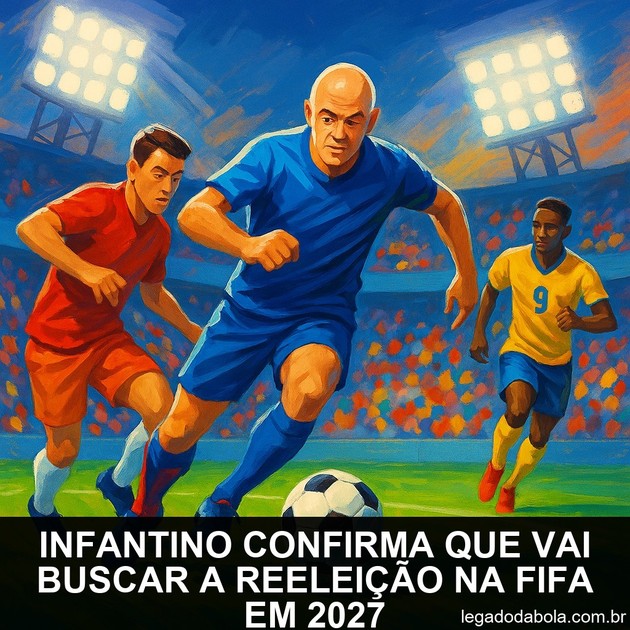
World football is once again debating its leadership. Gianni Infantino, president of FIFA, has publicly reaffirmed that he intends to stand for reelection, despite years of controversy surrounding his tenure.
The statement, reported by ESPN, is no bureaucratic footnote. Whoever runs FIFA shapes the calendar, competition formats and the distribution of billions of dollars to federations worldwide, including Brazil's CBF.
For fans in Brazil, the topic matters directly. FIFA decisions shape everything from the expanded Club World Cup to the dates that squeeze the schedules of Brazilian clubs.
The FIFA president steers the football of more than 200 federations. And Infantino has made it clear: he wants to stay on the throne.
What happened
Infantino reiterated his desire to run again for the presidency of football's governing body. The signal points to the elective congress expected in 2027, when his current term ends.
The Swiss official, of Italian origin, has held the job since 2016, when he won the election called after the fall of Joseph Blatter amid the biggest corruption scandal in the organisation's history.
Since then, Infantino has been returned to office in 2019 and again in 2023, both times without facing an opponent. Now he is making it clear he intends to repeat that script.
Infantino has never faced a rival at the ballot box since taking office: in 2019 and 2023 he was reelected unopposed.
Impact on clubs, national teams and competitions
Infantino staying on means continuity for his agenda: tournament expansion, the pursuit of new revenue and closer ties with markets outside Europe, such as the United States, the Middle East and South America.
For Brazilian clubs this cuts both ways. The expanded Club World Cup opened unprecedented doors and revenue for teams from the country, while the increasingly bloated calendar puts squads under growing physical strain.
For the Brazilian national team, FIFA's leadership matters too. World Cup formats, international windows and prize money criteria all cross the president's desk.
Reaction from the football world
Much of the European press greeted the news with scepticism, as Infantino's management is frequently criticised for concentrating power and for decisions seen as excessively commercial.
Among officials of smaller federations, however, the Swiss retains solid support. Increased FIFA payments to national associations have built a loyal electoral base in Africa, Asia and the Americas.
Player unions and European leagues remain among the loudest critics, pointing to calendar overload as the most visible effect of the Infantino era on those who actually play.
Player bodies and European leagues accuse FIFA of inflating the calendar with new tournaments without consulting the players.
Relevant history
Infantino came to power in February 2016, at a time when FIFA was mired in the crisis opened by the corruption investigations that brought down Blatter and much of the old leadership.
Before that he was general secretary of UEFA, right-hand man to Michel Platini. With the Frenchman suspended, Infantino became Europe's candidate and won the election promising transparency and reform.
In a decade in charge, he expanded the World Cup to 48 teams from 2026, created a 32-team Club World Cup and multiplied the organisation's revenues, always accompanied by governance questions.
Infantino took over in 2016, inheriting a FIFA in crisis after the scandal that toppled Joseph Blatter and officials across several continents.
Numbers and statistics
The numbers explain Infantino's political strength. FIFA has more than 200 member federations, and each has one vote at the elective congress, giving smaller associations enormous weight.
Under his leadership, the World Cup grew from 32 to 48 teams, starting with the 2026 edition in the United States, Canada and Mexico. The Club World Cup now features 32 teams in its new format.
If reelected in 2027 and completing a new term, Infantino would approach two decades at the helm of world football, comparable only to the long eras of Joao Havelange and Blatter.
What comes next
The next chapter is the 2027 elective congress. Until then, the big question is whether anyone has the political strength to challenge Infantino, something that did not happen at the last two elections.
Any rival candidacy would need formal backing from federations and a global campaign, a daunting task given the network of alliances built by the incumbent.
Meanwhile, FIFA faces a packed agenda: preparing the next World Cup cycles, consolidating the new Club World Cup and ongoing negotiations over the international calendar.
Expert opinion
Infantino's confirmation was expected, but it still sends a message. He feels strong enough to ignore the criticism and bet that the base of smaller federations will once again secure his stay.
FIFA's chess game is simple: every federation is worth one vote, and Infantino turned financial payments into political capital. Until European opposition presents a competitive name and a project that speaks to Africa, Asia and the Americas, reelection tends to be a formality. For Brazil, the challenge is different: capturing the revenue of the new tournaments without letting the calendar crush clubs and players.
Football needs to debate the model more than the names. Decades-long concentration of power, whether under Havelange, Blatter or Infantino, has rarely ended well for the sport's governance.
Infantino was UEFA general secretary and only became a candidate in 2016 because Michel Platini, then the favourite, was suspended by sports justice.