Context and Importance
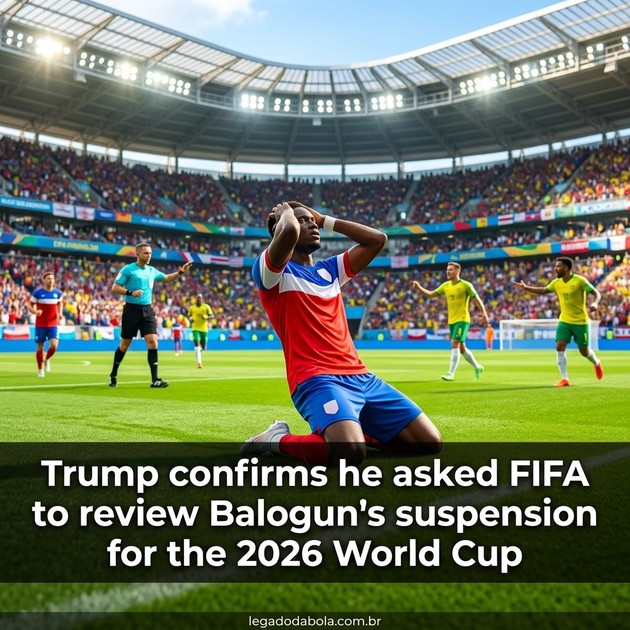
The 2026 FIFA World Cup was already delivering great moments on the pitch, but an off-field episode caught the attention of the entire world. United States President Donald Trump publicly confirmed that he contacted FIFA to request a review of the one-match suspension applied to US striker Folarin Balogun.
The case exposes an unprecedented tension between the political power of the host nation and the autonomy of international sporting bodies. It is rare, to say the least, for a head of state to directly intervene in the disciplinary decisions of a sporting competition. And the fact that FIFA reversed the ban makes the episode even more significant.
For American fans, Balogun is one of the team's key players. Losing him in an elimination match could seriously compromise the chances of the co-host nation. Trump's pressure, in this context, reflects the political and economic weight the tournament carries for the United States in 2026.
A president asking FIFA to overturn a disciplinary suspension is something without recent precedent in world football. FIFA's decision raises serious questions about independence and political pressure in sport.
What Happened
Folarin Balogun received a one-match suspension during the 2026 World Cup group stage. The ban would have kept him out of a crucial match for the United States, sparking outrage among fans and American authorities.
Donald Trump then confirmed he contacted FIFA to request the governing body review the decision. According to the president himself, FIFA analyzed the case and chose to suspend the ban, freeing Balogun to play. Trump said the organization made the 'right decision' and that otherwise it would have left a 'big stain' on the World Cup.
FIFA did not publicly detail the technical criteria that motivated the review. What is known is that the suspension was overturned and Balogun became available for the American squad. The episode took place in July 2026, in the middle of the tournament's knockout stage.
Trump personally confirmed he asked FIFA to review Balogun's suspension. The governing body accepted and reversed the ban, freeing the striker to play for the US national team.
Impact on the Team and Competition
Folarin Balogun is one of the most important strikers in the United States national team. Developed through Arsenal's youth academy, the player holds dual nationality (American and English) and chose to represent the USA. His presence in the knockout rounds is considered fundamental to the American team's ambitions in the tournament they co-host.
With the suspension lifted, the head coach could count on his main striker in the decisive stages. This changes the tactical planning and raises the expectations of American fans, who had been frustrated at the prospect of losing the player.
For the competition as a whole, the case creates a delicate precedent. If FIFA accepts reviewing punishments after political pressure from the host nation, this could raise questions about equal treatment between participating nations. Teams from less politically influential nations would hardly have access to the same kind of review.
FIFA reversed Balogun's suspension after Trump personally intervened - a precedent that world football will debate for years.
Reaction from the Football World
The news reverberated widely in the international sports media. Newspapers and specialist outlets questioned whether FIFA maintained its independence or gave in to political pressure from one of the most influential countries on the planet. The debate about the autonomy of sporting bodies returned with force.
American fans, on the other hand, celebrated the reversal of the ban and Balogun's return. For them, Trump's action was seen as a gesture of support to the national team. Social media in the US reacted enthusiastically to the news of the striker's clearance.
In other countries, particularly in Europe, the reaction was more critical. Journalists and former sporting officials questioned the impact of this type of interference on the credibility of FIFA and the tournament. The perception that the host nation has regulatory advantages is harmful to the image of the competition.
Relevant History
The relationship between politics and football has a long history of tensions. FIFA, over the decades, has always defended the principle of non-political interference in sporting matters - including punishing federations that experienced government interference in their internal affairs.
Folarin Balogun was born in the United States but developed his football in England, passing through Arsenal before playing for other European clubs. His choice to represent the American national team instead of England was a decision that greatly benefited the USA, who gained a technically refined striker.
World Cups hosted by politically influential countries have always generated episodes of tension with FIFA. In 2026, with the USA sharing the hosting with Canada and Mexico, the economic and political weight of the Americans over the tournament's organization is enormous. This episode with Balogun is another chapter of that complex relationship.
FIFA has previously suspended national federations for government interference in their affairs - which makes the acceptance of a direct request from a president even more contradictory with its own statutes.
Numbers and Statistics
Folarin Balogun is one of the most promising names in American football. Developed in Arsenal's youth categories, he accumulated spells at Premier League clubs and other European competitions before establishing himself as a regular starter for the US team.
The United States have never won a World Cup. In 2026, as co-hosts, they play with the pressure of an entire nation behind them. Balogun's presence - a technically refined striker shaped by European football - is seen as a genuine differential for the Stars and Stripes.
What Comes Next
With the suspension lifted, Balogun remains available for the United States' next matches at the 2026 World Cup. The focus now is entirely on the sport: the American team needs to convert home support and the bonus of playing on their own soil into results on the pitch.
For FIFA, the episode will likely generate internal debates about its own disciplinary processes. The governing body will need to clarify the criteria used to review suspensions, avoiding the perception that decisions can be changed by political pressure.
The Trump-Balogun case will go down in the history of the 2026 World Cup regardless of what happens on the pitch. If the USA advance, the episode will be remembered as one of the tournament's behind-the-scenes stories. If they are eliminated, it will be cited as an example that not all political interference resolves problems within the four lines.
Trump is known for his passion for golf, but his defense of Balogun showed that football also entered the White House's political radar during the 2026 World Cup.
Expert Opinion
This episode goes beyond football. When the president of the world's most powerful nation calls FIFA and the governing body reverses a disciplinary ban, what is at stake is the credibility of the entire regulatory system of the sport.
FIFA has clear statutes about non-political interference. It has punished federations for far less. Accepting a review after a presidential phone call - even if technically grounded - sends a dangerous message: that access to power counts as much as the rules on the pitch.
For Balogun individually, it is good news. The player had no fault in the political circumstances surrounding the case. But for football as an institution, the question that remains is: what if it had been Senegal, or Ecuador, or Guatemala requesting the same review? Would they have gotten the same result?
FIFA's decision to overturn Balogun's suspension following Trump's intervention is legally possible but politically devastating for the governing body's image. Football loses credibility every time decisions within the lines seem to be influenced by the power of those outside them. The 2026 World Cup will be remembered for this precedent, regardless of who lifts the trophy.