Context and Importance
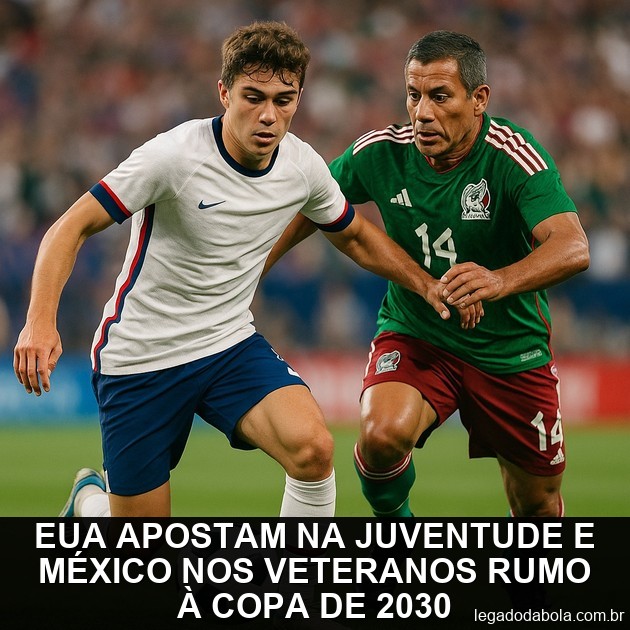
After the World Cup played on home soil, the United States and Mexico took very different paths. One bets on renewal. The other prefers experience.
Saturday's match is the first big test of that split. No trophy is at stake, but it offers early clues about who enters the road to 2030 stronger.
In Concacaf, this is the region's biggest rivalry. Any match between them carries weight beyond the score.
Two opposite projects, one stage: the USA and Mexico meet in search of the first answers for the 2030 cycle.
What Happened
According to ESPN, the two teams have taken drastically different approaches since the World Cup. The Americans bet on young players. The Mexicans keep a more seasoned group.
The difference shows in how the squad is built and in the idea behind the project. It is a long-term choice, not just a short-term one.
Saturday's meeting puts both philosophies face to face in this new cycle. The first signs of who holds the edge may come from there.
Impact on the Competition
Betting on youth buys time to mature. With a little under four years until 2030, a 20-year-old today could peak right at the next World Cup.
Betting on veterans follows another logic: immediate results, leadership and big-match knowledge. The risk is an aging group by then.
For Concacaf, the message is clear. Regional dominance may change hands as each project matures.
Youth versus experience: whoever gets the bet right arrives better in 2030.
Reaction from the Football World
The specialist press treats the match as a thermometer. The question driving the debate is simple: which path will be more efficient on the way to the next World Cup?
It is natural that American fans expect the renewal to bear fruit. Mexican fans, meanwhile, usually demand quick results, especially against their biggest rival.
On social media and in debate shows, the clash carries extra weight because everyone knows it works as a comparison between the two models.
Relevant History
The USA and Mexico share a rivalry that spans decades in Concacaf. Both countries also have a tradition as hosts: Mexico staged the tournament in 1970 and 1986, and the USA in 1994.
In 2026, the World Cup was held across three countries: the United States, Mexico and Canada. It was the first with 48 teams.
Mexico hosted the 1970 and 1986 World Cups, and the USA the 1994 edition. In 2026, both shared hosting duties with Canada.
This shared history makes every new chapter feel like a decider, even in matches with no title at stake.
Numbers and Statistics
The big-picture numbers help set the scale of the challenge. The 2026 World Cup was the first with 48 teams, a format that will also be used in 2030.
The 2030 edition marks 100 years since the first World Cup, played in Uruguay in 1930. The tournament will carry extra symbolic weight.
The 2030 World Cup will be hosted by Morocco, Spain and Portugal, with opening matches in South America to honor the centenary.
What Comes Next
The next chapter is Saturday's match. It is the first direct comparison between the two models in this cycle.
Until 2030, friendlies and Concacaf competitions will measure each project's progress. One game decides nothing, but the style of play tells a story.
The teams will also need to adapt to a World Cup on another continent, with long trips and a calendar different from what they lived at home.
Expert Opinion
I like the courage of those who renew early. A young team makes more mistakes, but it learns together and reaches 2030 with years of chemistry.
Veterans win Saturday's game more easily. Youth wins the 2030 World Cup if it works out. The question is who has the patience to wait for the result.
Mexico has the advantage of big-match knowledge. But the passing of time is a silent enemy. The ideal would be to blend both worlds before it is too late.