Context and importance
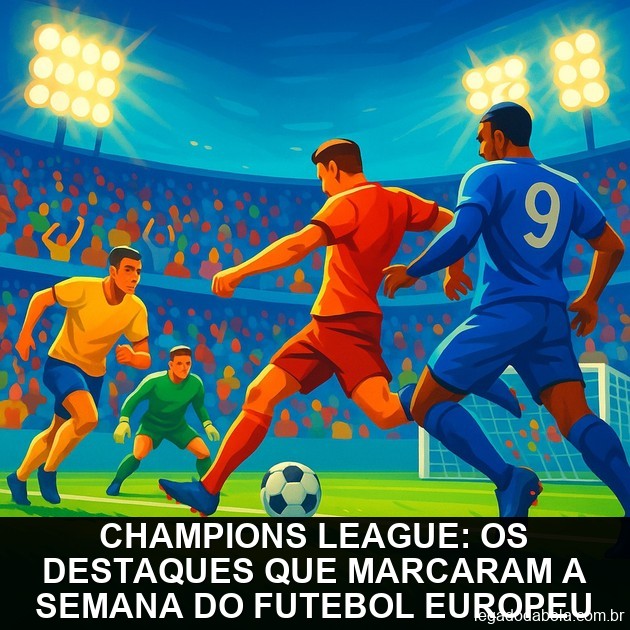
The Champions League remains the center of gravity of world club football. Every European week moves fans, markets and tactical debates on a global scale, and Brazil follows closely thanks to the many Brazilian players at Europe's biggest clubs.
The tournament is in a moment of transformation. Since the 2024-25 season, UEFA adopted a league phase with 36 clubs, replacing the traditional group stage. The change brought more heavyweight matches early in the competition and reshaped the qualification logic fans had known for decades.
Looking at the week's highlights is also a way of understanding where European football is heading: more matches, more revenue, more pressure on squads and coaching staffs. Every round is a chapter in a race that only ends at the final.
The Champions League is not just a tournament: it is the stage where football decides who rules Europe.
What happened
Champions League weeks concentrate the clashes between the continent's giants. Clubs like Real Madrid, Manchester City, Bayern Munich, PSG, Barcelona, Liverpool and Inter Milan arrive as favorites every season, and their direct duels usually set the tone.
In the new format, each club plays eight league-phase matches against eight different opponents, four at home and four away. The top eight in the overall table advance directly to the round of 16, while teams finishing 9th to 24th go through a knockout playoff.
This calendar engineering means big matches that used to happen only in the knockout rounds now occur in the opening weeks. The result is a more unpredictable competition from the start, with less room for rotation and more value on every point.
Under the league-phase format, the top eight advance directly to the round of 16, and every matchday can completely reshuffle the table.
Impact on clubs and the competition
For clubs, Champions League performance has a direct budget impact. UEFA prize money represents a huge share of annual revenue, and advancing a round can mean the difference between buying or selling in the next transfer window.
On the sporting side, the competition is the ultimate showcase. Players who shine on European nights see their market value soar, while managers who go deep gain instant prestige and early eliminations often cost jobs.
There is also an effect on domestic leagues. The pile-up of high-level matches forces big clubs to manage minutes, and favorites often stumble domestically in the middle of a decisive European week.
Reaction from the football world
The European sports press treats every Champions League round as a first-order event. Newspapers in Spain, England, Italy, Germany and France dedicate full front pages to the matches, and debate shows turn every result into a thesis about a club's future.
Among fans, reaction to the new format has been divided. Some celebrate the larger number of big matches early on; others miss the simplicity of the old group stage, where the qualification math was easier to follow.
In Brazil, interest remains huge. The constant presence of Brazilians in leading roles at Europe's top clubs keeps the Champions League mandatory viewing for local fans.
Europe's bloated calendar keeps drawing criticism from players and unions, who point to a growing injury risk from the relentless run of matches.
Relevant history
The European Cup was born in 1955 and rebranded as the Champions League in 1992. Since then it has become the most prestigious club competition on the planet, shaping entire eras of the game.
Real Madrid is the most successful club in its history with 15 titles, including the 2024 triumph over Borussia Dortmund at Wembley. The Spanish club has built an almost mystical relationship with the tournament.
Other giants wrote unforgettable chapters: AC Milan with seven trophies, Bayern Munich and Liverpool with six each, and Barcelona with five. In 2023 Manchester City won their first title, and in 2025 PSG finally lifted the trophy with a historic rout of Inter Milan in the final.
Created in 1955 as the European Cup, the competition became the Champions League in 1992 and has never stopped growing in audience and revenue.
Numbers and statistics
The Champions League's numbers impress from any angle. The league phase gathers 36 clubs and 144 matches before the knockout rounds even begin, far more than the old 32-team group stage.
Individually, Cristiano Ronaldo remains the competition's all-time top scorer with 140 goals, followed by Lionel Messi with 129, marks built over nearly two decades of dominance.
The financial weight is also enormous. UEFA distributes billions of euros per edition, and the final ranks among the most-watched annual sporting events in the world.
What comes next
The Champions League calendar keeps its relentless rhythm. After each block of league-phase rounds, the overall table redraws the picture: who fights for the top eight, who battles to stay in the top 24, and who plays only for pride.
The direct clashes between title contenders tend to concentrate toward the end of the league phase, raising the temperature week by week.
Then come the playoffs, the round of 16 and the road to the final. Each knockout stage is a tournament of its own, where details decide: a shot off the post, a misplaced pass, a substitution at the right minute.
Expert opinion
The new format delivered on its promise of more big matches, but at a price: the league phase demands deep squads like never before, and the gap between Europe's richest clubs and the rest has become even clearer.
At the same time, the single table created a new element of drama. Big teams that stumble early must treat November and December fixtures as finals, unthinkable in the old format.
For fans, the message is clear: the Champions League remains the ultimate benchmark of club football, and following its weekly highlights is following the evolution of the game itself.
The Champions League has become a marathon of sprints: every league-phase round is worth gold, and whoever manages their squad best between October and January reaches the knockouts alive. Titles are still decided by details, but endurance is now a prerequisite.