Context and Importance
The 2030 World Cup may still feel far away, but the United States national team is already moving toward it. Under Mauricio Pochettino, the USMNT is going through a rare period of open rebuilding, unafraid to take risks in the name of long-term growth.
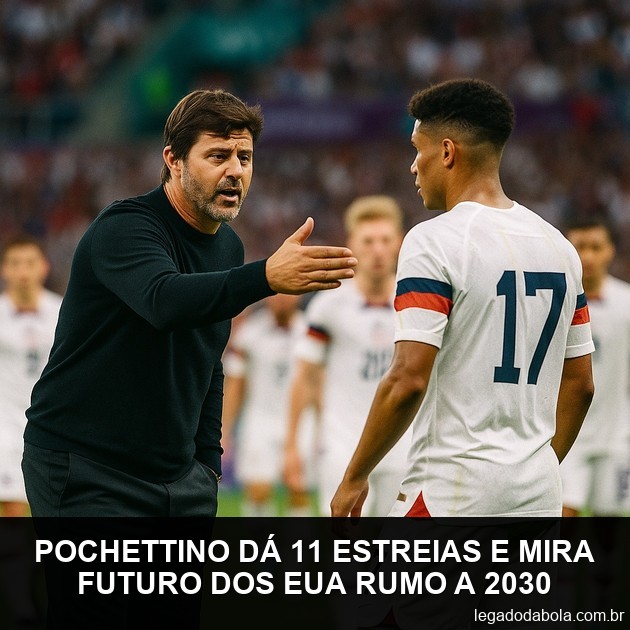
The Argentine coach chose a recent friendly to give minutes to a large group of players who had never worn the senior national team shirt. Eleven debuts in a single match is a number that speaks for itself about the urgency of this project.
More than a one-off test, Pochettino's gesture signals a shift in philosophy. Instead of shielding the squad with established names, the manager prefers exposing young players to international pressure as early as possible, buying time for collective maturity.
Pochettino handed 11 debuts in a single match, one of the biggest recent renewal moves for a national team with World Cup ambitions.
What Happened
In the friendly played over the weekend, Pochettino fielded a lineup packed with new names spread across different positions on the pitch. The decision was not casual, it reflected planning built behind the scenes by the coaching staff for months.
Players competing in European leagues and in MLS got their chance to show what they can offer wearing the national team shirt. Selection criteria favored physical form, club form, and medium-term potential over previous international experience.
Pochettino's approach reinforces a pattern expected since his arrival: using every friendly window as a laboratory, testing combinations and assessing who responds best under real match pressure.
Impact on the Team/Competition
For the USMNT, the immediate effect is a wider pool of available players. With more tested options, Pochettino gains flexibility to build different tactical systems depending on the opponent and the moment of the competition.
The renewal also changes the internal dynamic of the group. More experienced players now compete for spots with emerging talents, which tends to raise the overall standard of training and upcoming call-ups.
From a competitive standpoint, this bet on youth creates a foundation that can mature together over the next cycles, essential for a national team with big ambitions for the near future of American soccer.
Eleven debuts in one match is not just a statistic, it is a statement of intent about the USMNT's direction.
Reaction from the Football World
Pochettino's move generated immediate reaction among analysts and fans closely following the growth of soccer in the United States. The overall mood is one of positive anticipation with new blood arriving.
Commentators highlighted the boldness of the decision, especially since it happened outside an official competition, where the risk of mistakes carries fewer immediate consequences. This kind of boldness tends to be well received when paired with a clear plan.
There are also voices urging caution, noting that friendly debuts do not automatically guarantee spots in future call-ups. The real test comes when these players face matches of greater competitive intensity.
Renewing a squad on the eve of a World Cup cycle is a rare strategy, but historically associated with national teams seeking to build their own long-term identity.
Relevant History
United States soccer is going through a period of accelerated expansion, driven by hosting the 2026 World Cup alongside Mexico and Canada. This context had already been pushing the federation to speed up the development of new talent.
Pochettino took over the USMNT with the mission of balancing immediate results with long-term construction. His career as a coach has always been marked by valuing young players, something seen in previous spells at European clubs.
The idea of already looking toward 2030 is not random. After hosting the 2026 World Cup, the United States enters a new development cycle, and the base being formed now could be exactly the one representing the country in the next edition of the tournament, which will feature an expanded format across three continents.
Numbers and Statistics
The number of 11 debuts in a single match stands out for representing almost half of a complete starting lineup, reinforcing the experimental yet strategic nature of the call-up.
This volume of renewal also signals the coaching staff's confidence in the pool of available players, whether playing in European leagues or in the growing MLS, which has consistently produced talent in recent years.
More than the isolated number, what matters is the context: a national team using a friendly to speed up decisions that would normally take several cycles to mature.
What Comes Next
The trend is for Pochettino to keep using upcoming friendly windows to test more combinations, gradually expanding the pool of players with international experience for the senior team.
The continental competition calendar should serve as the next real gauge, since it offers matches with greater competitive pressure than isolated friendlies. That is where many of these debutants will need to confirm the potential they showed.
With the 2030 horizon in mind, every call-up from now on tends to be treated as part of a continuous project, not isolated events, which changes how fans should follow this transition phase.
Expert Opinion
Decisions like Pochettino's are rarely popular in the short term, because they sacrifice immediate results in exchange for future construction. But national teams that win major tournaments have often gone through similar phases of collective renewal.
What stands out in the USMNT's case is the timing: right after hosting a World Cup, with public attention still high, using this window to reorganize the squad is a smart piece of sporting planning.
Eleven debuts in one match show that Pochettino is not just thinking about the next game, but about what USMNT the world will find years from now. It is a long-term bet, and American soccer seems willing to pay for it.
If these young players mature at the expected pace, the United States could arrive at 2030 with a more experienced, cohesive group, ready to compete on equal footing with the traditional powers of world football.