Context and Importance
The Brazilian national team arrived at the 2026 World Cup carrying one of the highest expectations in recent years. With a squad full of top names, Brazil placed a great deal of trust in the creativity and vision of Lucas Paquetá to orchestrate the midfield. That is why the confirmation of a muscular injury to the midfielder set off alarm bells within the technical staff and among the fans.
Paquetá is a central piece in Brazil's tactical setup. His ability to connect the defense to the attack, to appear between opposition defenders to receive and turn, and to create plays out of thin air makes him one of the hardest players to replace in the squad. Losing him, even temporarily, represents a considerable reshuffle in the team's gears.
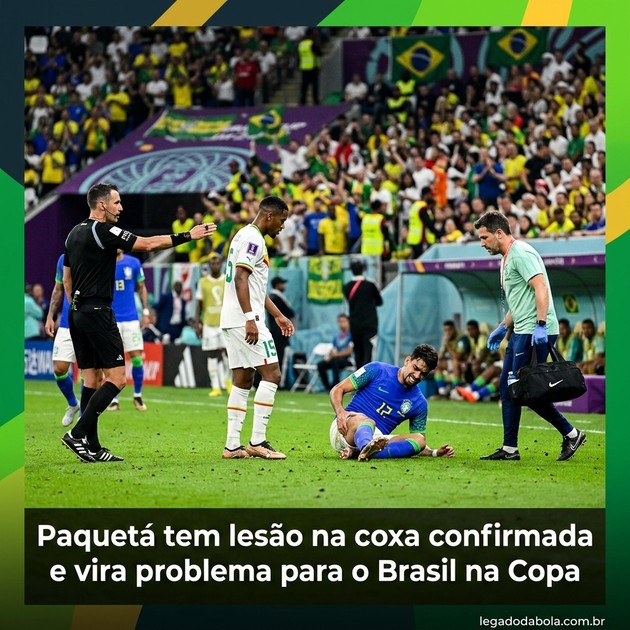
The injury was confirmed by the technical staff after medical exams at the national team's training center. The diagnosis pointed to a muscle injury in the left thigh, a condition that requires careful management and puts the midfielder's participation in upcoming matches in doubt.
Paquetá and Raphinha are both undergoing intensive treatment. The technical staff monitors both cases individually to decide on their availability for upcoming matches.
What Happened
During the 2026 World Cup, Lucas Paquetá felt muscular discomfort in his left thigh. Brazil's medical staff carried out exams and confirmed the injury, which is muscular in origin. The midfielder was immediately placed on an intensive treatment protocol to speed up recovery.
The good news, within a concerning scenario, is that Paquetá was not sent home and remains integrated with the group. This means the technical staff considers his return during the tournament possible, depending on how his condition evolves over the coming days.
Raphinha, another key name in the squad, is in a similar situation and also undergoing intensive treatment. Brazil therefore faces a delicate moment, with two of its main creative players racing against the clock to recover and be available for the decisive stages of the competition.
With Paquetá and Raphinha in doubt, Brazil must solve a problem no fan wanted to face at the World Cup.
Impact on the Team and Competition
The absence of Paquetá directly affects the balance of Brazil's midfield. He is the player who connects lines, who drops between opposition defenders to receive and turn, who drags markers and creates space for attackers. His absence is not just numerical - it is qualitative.
The technical staff will have to reorganize its pieces. There are alternatives in the squad, but none that precisely replicate what Paquetá offers. The manager will need to adapt the system or back a different player to fill the role of an organizing midfielder with freedom to appear in attack.
In the context of the World Cup, every match counts. Going into an elimination game without one of the squad's best creators is a risk the technical staff would rather not take. The pressure on available players increases, as does the rest of the group's responsibility to maintain the expected level of performance.
The West Ham midfielder is Brazil's main midfield organizer. His mobility and vision are difficult to replicate within the current squad.
Reaction from the Football World
The news quickly spread across social media and specialist football outlets. Brazilian fans expressed concern, while analysts and former players began debating who could step into Paquetá's role if he is unavailable.
The Brazilian and international sports press treated the injury as a significant development within the World Cup, given the player's importance to the national team's system. Paquetá's name quickly trended, reflecting the anxiety of the green and yellow faithful.
In the European football environment, where Paquetá plays for West Ham in the Premier League, the injury also drew attention. The player came off a high-level season and arrived at the World Cup as one of the most watched midfielders in the tournament. Seeing his participation threatened só early was a surprise for many.
Historical Context
Lucas Paquetá has had a journey of highs and lows with the Brazilian national team, but in recent years he has cemented his place as an undisputed starter. His distinctive style - with the freedom to roam across the pitch and shoot from distance - has made him one of the players most associated with the attacking football Brazil wants to play.
In his career, Paquetá passed through Flamengo, AC Milan and Olympique de Lyon before establishing himself at West Ham. With the national team, he has participated in Copa América tournaments and South American qualifiers, accumulating experience in high-level competitions.
Brazil itself knows what it means to lose key players at World Cups. In 2014, the absence of Neymar in the semifinals was a trauma that still echoes in the fans' memory. Paquetá's situation does not reach that level of impact, but it awakens the collective memory of a football culture that has suffered too much from unexpected absences at decisive moments.
In 2014, losing Neymar before the semifinal contributed to the historic 7-1 defeat to Germany. Brazil learned that injuries at World Cups can change everything.
Numbers and Statistics
The numbers help illustrate how relevant Paquetá is to the Brazilian national team. In his most recent appearances for Brazil, the midfielder consistently ranks among the players with the most goal involvements, combining assists and shots with regularity.
Raphinha, who is also in treatment, is Brazil's top scorer and assist provider in attack. Having two such important players out of action at the same time represents a loss of creative quality that is hard to quantify but impossible to ignore on the pitch.
The 2026 World Cup is played in an expanded format with 48 teams. Brazil, as one of the tournament's powerhouses, is expected to go deep in the competition. Every result in the early stages matters for the path the team will take toward a potential final.
What Comes Next
The coming days will be decisive for Paquetá's World Cup. The technical staff monitors the injury's progress closely, and after each treatment session the medical team assesses whether the midfielder is fit to play. The recovery window is tight, but it is not closed.
If Paquetá cannot recover in time for upcoming matches, Brazil will need to find an adequate replacement within the squad. The team has quality midfielders, but the specific function Paquetá performs requires very particular characteristics, and the manager will need to be creative in finding a solution.
Brazilian fans are hoping the treatment works quickly. The World Cup is football's biggest stage, and seeing Paquetá return to the pitch in good health and wearing the yellow shirt would be an enormous relief for the entire country. Until then, all anyone can do is support the team and anxiously await the next medical updates.
Expert Opinion
Following a World Cup with two of Brazil's key players racing against the clock in the physiotherapy room is not something any fan wanted to see. But it is the reality the national team now faces.
Paquetá's injury is not just the loss of a player. It is the loss of a system. Brazil builds much of its offensive football on the midfielder's ability to appear in areas that most players in his position simply do not reach. Without him, the team loses fluidity, loses the connection between midfield and attack, loses the unpredictability that can frighten any defense in the world. The technical staff will need tactical creativity and fast answers. At a World Cup, time is the one thing in short supply. And improvised solutions rarely work when the opponent is strong. Brazil has enough talent to overcome this moment, but it will need someone to step up unexpectedly. That is football. That is the World Cup. And that is exactly why this tournament is só passionate and só cruel at the same time.