Context and Importance
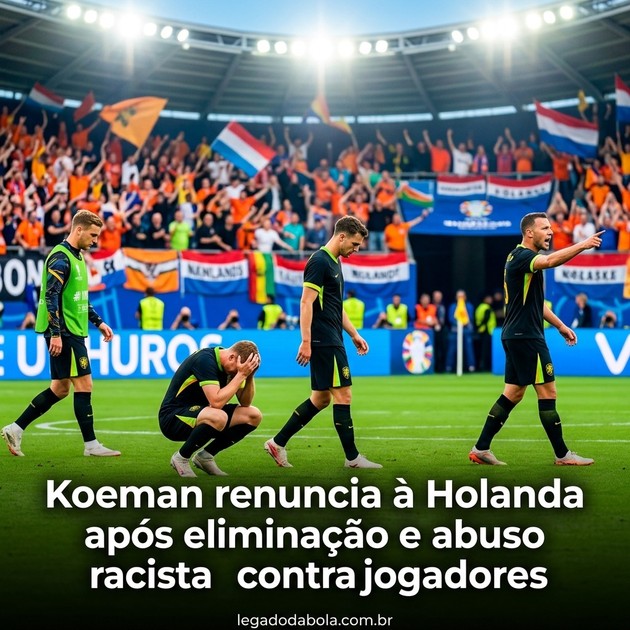
The 2026 World Cup has left a painful mark on the Netherlands. The elimination alone would have been hard enough to swallow, but what followed shook European football: players who missed penalties were subjected to racist abuse só severe that the Dutch football federation itself described it as "appalling".
Against this backdrop of crisis both on and off the pitch, Ronald Koeman announced his resignation as Netherlands manager. The coach who had restored credibility and identity to the Dutch national team ended his tenure in one of the most bitter exits in the recent history of Dutch football.
The episode shines a harsh light on a problem football refuses to solve: racism in the stands and, increasingly, on social media. The Dutch case is yet another alarm bell that cannot be ignored.
The Dutch football federation described the racist abuse suffered by players after the elimination as "appalling". Authorities and clubs were contacted to identify those responsible.
What Happened
The Netherlands were knocked out of the 2026 World Cup in a penalty shootout. Some players missed their kicks and, in the hours that followed, were bombarded with racist hate messages on social media. The Royal Dutch Football Association (KNVB) was quick to condemn the attacks in the strongest possible terms.
Days after the elimination, Ronald Koeman formally stepped down. The 63-year-old had taken charge of the Netherlands in 2023 and guided the team to the latter stages of the World Cup, but his cycle came to an abrupt and bitter end.
The KNVB confirmed the resignation and pledged to work with digital platforms and authorities to identify and hold accountable those responsible for the attacks. The case was referred to Dutch police.
Koeman announced his resignation shortly after the 2026 World Cup. He had returned to the Netherlands job in 2023 after a previous stint between 2018 and 2020.
Impact on the Team and Competition
The Netherlands are now without a manager and must rebuild their project for the next generation of competitions. Koeman's exit opens a search for a new name capable of maintaining the Dutch football identity, known for attacking football combined with defensive organisation.
The racist abuse is, however, the deepest wound. Players who already carry the burden of missing in a major competition also had to deal with attacks that go far beyond football. This kind of trauma can directly affect these athletes' relationship with the national team and with the sport itself.
For the World Cup as a whole, the case is a reminder that events of this magnitude still have no effective solutions to contain the hatred that erupts on social media after negative results. FIFA and the confederations continue to face pressure for tougher measures.
Reaction from the Football World
The news was met with outrage across Europe. Federations, clubs, players and supporters from different countries spoke out against the racist abuse suffered by the Dutch players. Solidarity was immediate and crossed borders.
Within the Netherlands itself, the shock was enormous. The local press highlighted the cruelty of the attacks and demanded those responsible be punished. The debate about racism in football returned forcefully to the centre of discussions, with voices calling for tougher penalties both in the sporting and criminal spheres.
Koeman's departure also sparked debate about the team's future. Names of possible successors are already circulating in the Dutch media, but the moment is one of mourning for the end of a cycle and of anger over what happened to the players.
Koeman has a profound connection to the Dutch national team as a player too. He scored the winning goal in the 1988 European Championship final, the greatest achievement in Dutch football history.
Relevant History
Ronald Koeman has one of the richest stories in Dutch football. As a defender, he won the European Championship in 1988 and the Champions League with Barcelona in 1992 with that iconic free-kick in the final. As a manager, he worked at Ajax, Benfica, Valencia, Southampton, Everton and Barcelona before taking the national job.
His first stint with the Netherlands was between 2018 and 2020, a period in which the team reached the Nations League final. He returned to the role in 2023 and guided the squad to the semi-finals of Euro 2024. The 2026 World Cup was meant to be the crowning achievement of the cycle.
Dutch football carries the scars of lost finals. The team reached three World Cup finals without lifting the trophy, in 1974, 1978 and 2010. Once again, the promise of a talented generation did not convert into the ultimate prize.
The Netherlands have lost three World Cup finals. In 2026, the pain of elimination came alongside something far more serious: racism against their own players.
Numbers and Statistics
The figures from Koeman's time in charge of the Dutch national team show a solid body of work, with impressive performances in major competitions. The team consistently ranked among the best in Europe and the world during his tenure.
The penalty problem, however, has been a shadow over the Netherlands in decisive knockout ties. The shootout remains a weakness that coaches and sports psychologists have tried, without definitive success, to address.
What Comes Next
The Dutch federation must now begin the search for a new manager immediately. The process is expected to be thorough, as the squad has young talent and needs a clear project for the next cycles, including the Euros and the next World Cup.
On the front of combating racism, the KNVB pledged not to back down and to work to ensure those responsible for the attacks are identified and punished. Pressure from Dutch society and international football should force concrete action in the coming weeks.
For the players who suffered the attacks, psychological support and solidarity from teammates and the federation will be crucial. Football can be brutal, but nothing justifies racial hatred. The next chapter for the Dutch national team begins with an obligation to show that the country does not tolerate this kind of behaviour.
Expert Opinion
Ronald Koeman's legacy with the Dutch national team goes beyond results. He restored identity and belief to a group that had lost its way. His departure now is understandable within the sporting cycle, but the moment demands that football stop debating and start acting decisively against racism.
The problem is not holding a player accountable for missing a penalty. That is part of sport. The problem is when that accountability becomes racial hatred, cowardice hidden behind phone screens. The Netherlands need a new manager. But world football needs something more urgent: the courage to genuinely punish those who use sport as a shield to practise racism. Koeman walks away. Racism, unfortunately, seems to want to stay.