Context and Importance
The Netherlands is one of the most traditional footballing nations in the world. Three World Cup finals, a European Championship and a tactical school that influenced generations make the Dutch one of the most respected countries in the sport. But since 1988, the country has been searching for its second major international title.
Ronald Koeman returned to the role in 2022 for his second stint in charge of the Netherlands. The mission was clear: take the Dutch back to the latter stages of a World Cup and restore the belief that the Netherlands could truly compete for a title.
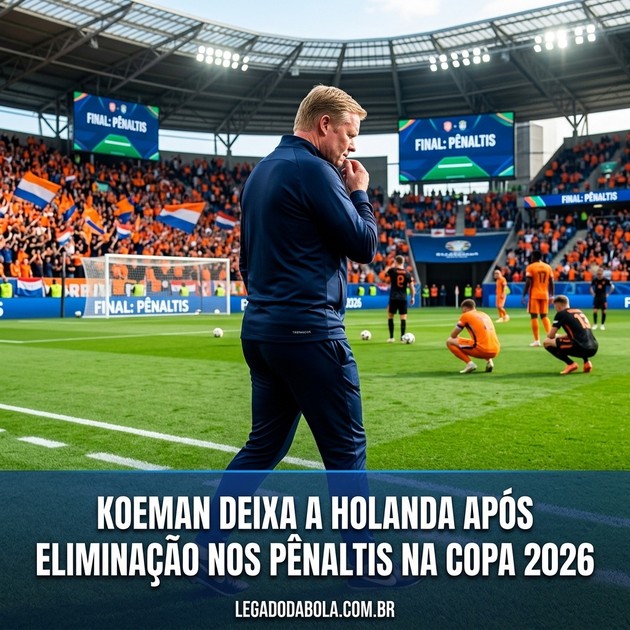
That cycle ended on June 30, 2026, when it was confirmed that Koeman would not continue after Morocco knocked the Netherlands out on penalties in the round of 16 of the World Cup.
The Netherlands has not reached the quarterfinals of a World Cup since 2014, when they finished third in Brazil. The cycle of early exits continues.
What Happened
In the round of 16 of the 2026 World Cup, the Netherlands faced Morocco in a balanced match that ended level after regular time. The decision went to penalties, where the Dutch came out on the losing side and were eliminated from the tournament.
The defeat on penalties ended the Dutch dream in this edition of the World Cup. A bitter elimination, especially considering the quality of the squad available to Koeman and the expectations heading into the competition.
With the elimination confirmed, the departure of the manager was announced. Koeman and the Dutch football association, the KNVB, reached the natural end of a cycle that began in 2022 and lasted approximately four years.
Koeman managed the Netherlands in 44 games during his second stint, recording 24 wins and securing qualification for the 2026 World Cup.
Impact on the Dutch National Team
Koeman's departure leaves the Netherlands at a delicate crossroads. The team will need to find a new manager to guide the squad through upcoming commitments, including the Nations League and a new qualification campaign.
The Dutch squad has undeniable quality at the highest level. Players like Virgil van Dijk, Frenkie de Jong and Cody Gakpo are in or approaching their prime. The challenge for the next coach will be turning individual talent into collective achievement.
The KNVB faces the task of attracting a respected name to the position. Managing the Netherlands national team is a prestigious role, but it comes with enormous pressure. The fans demand titles, and patience has its limits.
Reaction from the Football World
The news of Koeman's departure spread quickly through the European press. Dutch media generally understood the decision as a natural consequence of an early World Cup exit. Losing in the round of 16 rarely spares any manager, regardless of prior work.
Supporters were divided. Some acknowledge the coach's work and lament the cruelty of penalties, which can change the course of any story. Others believe the team needed a deeper renewal, in playing style and competitive mentality alike.
On the international stage, Koeman's work is viewed with respect. Qualifying a nation for the World Cup and reaching the second round is solid management. But for a country of the Netherlands' stature, it simply isn't enough.
A penalty shootout is the cruelest way to be eliminated in football. Koeman pays the price for a decision that could have gone either way on a different night.
Relevant History
Ronald Koeman has a deep connection to the history of the Netherlands. As a player, he won the European Championship in 1988 alongside Ruud Gullit, Frank Rijkaard and Marco van Basten. His free-kick goal in that final against the Soviet Union remains one of the most iconic moments in Dutch football history.
As a manager, his first stint with the national team ran from 2018 to 2020. During that cycle, he took the Netherlands to the Nations League final and secured qualification for Euro 2020. It was a well-regarded effort that opened the door to his move to Barcelona.
After a turbulent spell at the Catalan club, Koeman returned to the Dutch national team in 2022. He guided the team to the 2026 World Cup without major drama, but the cycle ended without the trophy the Netherlands have been chasing since that magical night in 1988.
The Netherlands were World Cup runners-up in 1974, 1978 and 2010. Three lost finals that define both the greatness and the tragedy of Dutch football.
Numbers and Statistics
The figures from Koeman's second spell in charge of the Netherlands show a consistent performance across the cycle. Forty-four games in total, with 24 victories, representing a positive win rate for a national team manager.
The number of wins reflects a team that won more than it lost over the course of the process. But in World Cup football, what matters is the result at the decisive moment, and there the Netherlands fell short of expectations.
As a player, Koeman made more than 70 appearances for the Dutch national team and scored important goals in major competitions. His legacy as a footballer is beyond dispute. As manager of the same team, the balance is positive but unfinished.
What Comes Next
The KNVB will need to act quickly to appoint the next Netherlands manager. The European football calendar leaves no room for hesitation, and the Nations League is already on the horizon for the coming months.
Names connected to Dutch football and high-profile foreign coaches are expected to emerge as candidates. The federation has a tradition of backing managers with the DNA of Total Football, the philosophy that made the Netherlands a world power in the 1970s and 1980s.
For the players, this moment can represent a turning point. With new leadership and a fresh approach, the Netherlands have the tools to impress the world again before the next World Cup.
The Netherlands has always produced innovative coaches. Johan Cruyff, Louis van Gaal and Koeman himself are examples of managers who shaped how modern football is understood and played.
Expert Opinion
Koeman's departure was expected after the elimination. At the highest level of football, losing a World Cup in the round of 16 does not sustain any manager in post, regardless of the work built across the cycle. That is the reality for any major footballing nation, and the Netherlands is no different.
What remains is the image of a squad with world-class players that has yet to find the formula for turning individual talent into collective success. That is the real problem the next manager must solve, whoever they turn out to be.
Koeman was competent. He qualified, organised, and won more than he lost. But the World Cup demands more than competence. It demands that special spark that wins a penalty shootout or creates the decisive goal in the hardest moment.
Koeman leaves with his dignity intact. He qualified the Netherlands for the World Cup, kept the squad cohesive and reached the second round. But football is ruthless, and penalties exact their toll without mercy. The next manager inherits a squad of real quality. The challenge will be going further than Koeman managed to. The Netherlands deserves more than a round of 16 exit, and every Dutch football fan knows that better than anyone.