Context and Importance
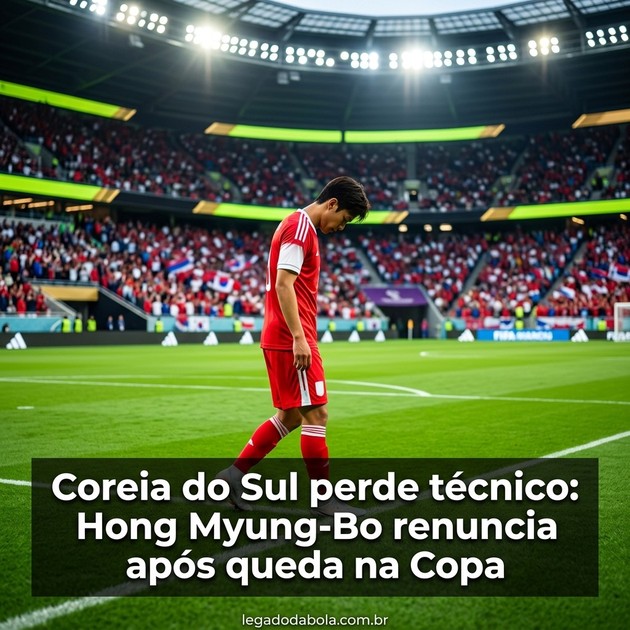
The World Cup does not forgive. A short run becomes a crisis within hours, and that is exactly what happened with South Korea. Coach Hong Myung-Bo announced his resignation on Sunday, just one day after the Asian side made an early exit from the tournament.
The case matters because South Korea are no ordinary team in Asian football. They are one of the most traditional forces on the continent, regular at World Cups and owners of memorable runs in the past. When a team of that stature falls early, the impact is huge.
More than that, the departure took on a political weight. The pressure on Hong Myung-Bo did not come only from fans or the sports media. It also came from high-ranking figures, including critical statements linked to the country's president. When politics enters the football debate, the situation becomes unsustainable.
What Happened
South Korea were knocked out of the World Cup quickly, below what was expected from a team carrying their Asian tradition. The early exit dashed expectations and immediately opened a wave of demands.
The day after leaving the tournament, Hong Myung-Bo formally resigned from the coaching role. The decision was made in a heavy atmosphere, with criticism coming from several directions about the staff's work.
Among the voices that pushed for change was that of the country's own president, according to the report released. This kind of public statement from a top authority usually speeds up any departure, and it was no different with Hong.
Impact on the National Team
Losing the coach right after a World Cup opens an immediate gap at the top of South Korea. The federation will have to reorganize the national team project almost from scratch, defining a new name and a new playing idea for the next cycle.
Changing coach at the end of a campaign also affects the group of players. Athletes who were being shaped one way will have to adapt to another philosophy, and part of the squad may go through natural renewal over time.
There is also an image cost. A quick elimination combined with a turbulent resignation gives the feeling of instability. For a team used to qualifying and competing as a protagonist in Asia, this scenario demands a fast response só it does not turn into a prolonged crisis.
Reaction From the Football World
The reaction was intense. An early exit by a traditional team always generates great scrutiny, and South Korea did not escape the gaze of the sports media and fans.
The tone of the criticism was direct. There were questions about choices, about the team's performance in the tournament and about how the squad's potential was used. When a team falls early, the coach is usually the first target, and that is what was seen.
The detail that drew attention was the weight of the criticism coming from the political sphere. Statements linked to the country's president turned a sporting debate into a matter of national interest, further increasing the pressure on Hong Myung-Bo.
Relevant History
Hong Myung-Bo is a name of enormous weight in South Korean football. As a player, he was one of the great symbols of the national team, a reference defender and a leader in remarkable generations of the country.
His bond with the national team was always strong, which makes the resignation even more symbolic. Seeing a figure só identified with South Korea leave the job under pressure shows how worn down the environment became.
South Korea, in turn, built a solid history at World Cups, with frequent appearances and standout moments that placed them among the main Asian forces. This record of being a protagonist is precisely what raises the demands when the result falls short.
Numbers and Statistics
South Korea rank among the Asian teams with the highest number of World Cup appearances, a mark that reinforces their tradition in the tournament over the decades.
The elimination in this edition was classified as early, meaning the team left the competition in an initial phase, far from the decisive rounds that are usually the goal of a side with this history.
The gap between the fall and the resignation was minimal: about one day separated the elimination from the announcement of the coach's departure. That short time sums up the intensity of the pressure faced by Hong Myung-Bo.
What Lies Ahead
South Korea's next step is to define a new manager. The federation will have to assess names capable of lifting the group's morale and restoring the fans' confidence after the World Cup frustration.
It will also be necessary to plan the next cycle, thinking about Asian competitions and the upcoming road toward a future World Cup. Rebuilding a project takes time, and the choice of coach will be decisive in that process.
In the short term, the challenge is to manage the mood. A well-handled transition can turn the crisis into a fresh start. A poorly handled transition can prolong the instability far longer than the fans would like.
Expert Opinion
What happened with South Korea is a raw portrait of how national-team football works. The World Cup concentrates years of work into a few weeks, and the judgment is merciless. An early fall quickly erases any accumulated credit.
The resignation of Hong Myung-Bo carries strong symbolism because he is an icon of the country. It shows that not even a historic bond with the national team protects a coach when results do not come. In football, the past counts for little against a bad present.
The most delicate point is the interference of the political sphere in the debate. When the demands go beyond the sporting field and reach the highest level of government, the environment becomes explosive. South Korea now need to separate emotion from planning and calmly build the next chapter of their national team.