Context and Importance
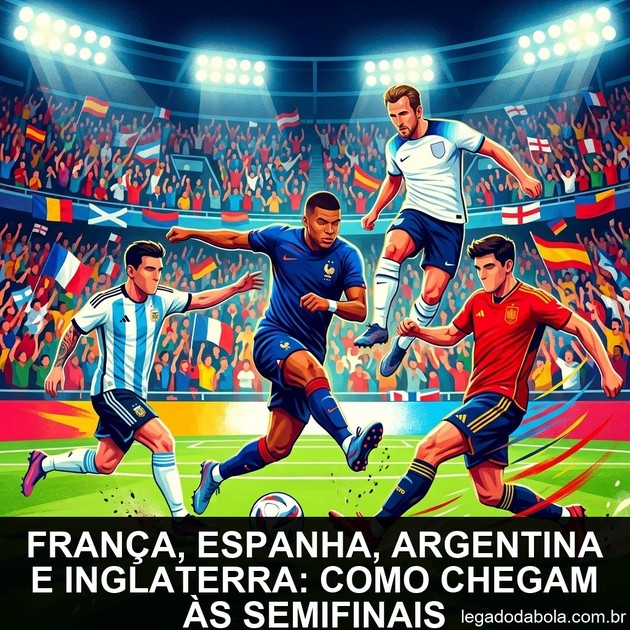
The World Cup semi-finals are just days away, and the tournament has already revealed four teams with very different profiles. France, Spain, Argentina and England arrive at this stage with distinct paths, but all with legitimate claims to lift the trophy.
Understanding each team's numbers helps explain why this knockout stage promises to be só balanced. It is not just about individual talent, but about how each coach organizes the team tactically throughout matches.
BBC Sport gathered data on attacking efficiency, chance creation and aerial performance for the four finalists. These numbers paint a clear picture of what each side does best in this World Cup.
The four semi-finalists represent almost opposite playing styles, promising rich tactical battles at this stage of the competition.
What Happened
Throughout the group stage and knockout rounds, each team built its own identity. France stood out for turning few chances into goals, a trait that has been a trademark in previous World Cups.
eSpain, on the other hand, relied on possession and collective build-up play, creating a large volume of chances even without always converting them into goals.
Argentina showed a balance between solid defense and clinical attacks, while England surprised with its success in set pieces and aerial play, a traditional strength of English football.
Impact on the Team and Competition
These contrasting styles make the semi-finals a real tactical laboratory. A clash between French efficiency and Spanish creativity, for example, is likely to be decided by small details.
For coaching staffs, understanding the opponent's pattern is essential to building a game plan. Teams that dominate in the air, like England, tend to exploit corners and free kicks as an extra weapon.
More clinical sides, such as France, tend to play more cautiously, waiting for the right moment to strike on quick transitions and counter-attacks.
In the semi-finals, it is not who has more possession that wins, it is who best converts the chances they create.
Reaction from the Football World
Expectations among fans and analysts are high. European sports media has been intensely debating which playing style will prevail at this decisive stage of the competition.
Commentators point out that the balance among the four teams makes any prediction risky. There is no clear favorite, which only increases anticipation for the matches.
Fans from all four nations are already flooding social media with analysis and comparisons, a sign that interest in the tournament keeps growing as the final approaches.
Relevant History
France has a recent tradition of going far in World Cups, often relying on a lethal attack even while creating fewer chances than opponents.
France, Spain, Argentina and England all have a history of World Cup finals and titles, reinforcing the high level of this stage of the competition.
Spain carries the legacy of the possession football that defined an era a few years ago, while Argentina has always brought a tradition of decisive players in pressure moments.
England, in turn, is seeking to repeat or surpass recent campaigns, trying to finally return to deciding a world title after decades of waiting.
Numbers and Statistics
Data gathered by BBC Sport shows clear differences between the four teams in aspects such as shots, chance creation and efficiency in aerial duels.
These numbers reinforce that, despite the different styles, all four teams arrive at this stage with solid credentials to fight for the title.
What Comes Next
The semi-finals promise balanced matchups, with each coach adjusting their strategy according to the opponent's profile. Deciding who advances to the final should come down to tactical details.
Decisive players are expected to gain even more prominence, especially in set-piece situations and counter-attacking finishes, strengths of more than one of these teams.
Football fans around the world now wait to see which playing style will prevail and which two teams will fight for the trophy in the grand final.
Expert Opinion
These four playing styles show there is no single formula for winning a World Cup. Efficiency, creativity and aerial strength are all equally valid paths when well executed.
What decides a World Cup at this stage is not just individual talent, but each team's ability to impose its style precisely when the opponent tries to neutralize it. The semi-finals will reveal who does this best under pressure.
It remains to be seen how each coaching staff will adapt its strategy. The tournament has already proven that balance is the keyword of this World Cup edition.