
Context and Importance
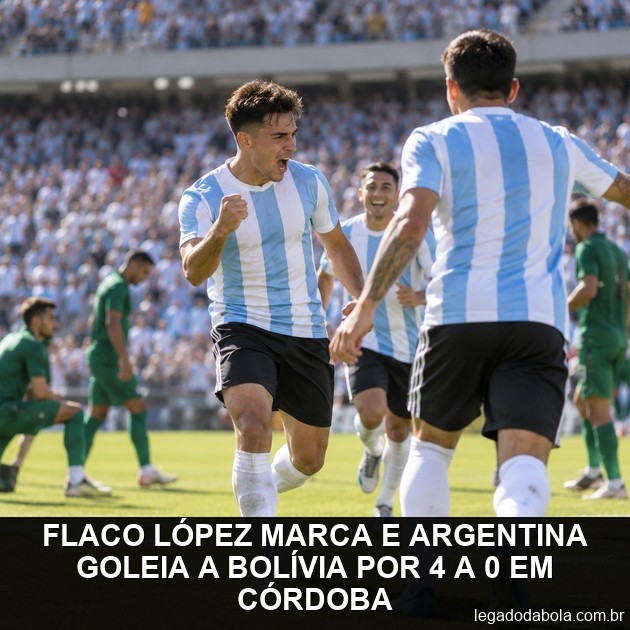
Argentina took the field for the first time since finishing runners-up at the 2026 World Cup. And they came back the way fans love: a 4-0 thrashing of Bolivia in a friendly played on Wednesday.
The match carried symbolic weight. Losing a World Cup final leaves deep scars, and the first game after such a blow often reveals a lot about a squad's state of mind.
For Brazilian fans, there is an extra ingredient. One of the goals came from Flaco López, the Palmeiras striker well known to anyone who follows the Brasileirão.
Argentina's first game after the 2026 World Cup final ended in a 4-0 rout, with a goal from a striker who plays in Brazilian football.
What Happened
The match was played at the Estádio Mario Alberto Kempes in Córdoba on Wednesday, September 30, 2026. A venue full of symbolism for Argentine football.
Argentina built a 4-0 scoreline and turned the friendly into a reunion with their fans. The wide margin reflects the technical gap between the two sides.
Flaco López got on the scoresheet and became one of the most talked-about names of the night, especially in Brazil, where he plays for Palmeiras.
Impact on the National Team and the Competition
The rout opens a new cycle. After a World Cup, national teams usually use their first friendlies to test players, refresh the squad and recalibrate for the next four years.
In that scenario, scoring in the very first game is gold. Argentina's attack is historically crowded, with names like Lautaro Martínez and Julián Álvarez in the recent picture.
For Palmeiras, the goal has practical effects too. A striker who shines for his national team gains market value and confidence for the rest of the Brazilian season.
After losing a World Cup final, nothing heals faster than a home rout.
Reaction from the Football World
The result was treated as a fresh start. Argentina's first post-World Cup image was eagerly awaited, and the big win helps shake off the hangover of a lost final.
In Brazil, the natural headline was Flaco López's goal. The story got space in the sports press, such as Gazeta Esportiva, precisely because of his link to Palmeiras.
For Palmeiras fans, seeing one of their players score for Argentina is a source of pride. It is also a sign that Brazilian football remains a showcase for South American talent.
Relevant History
The Estádio Mario Alberto Kempes hosted matches at the 1978 World Cup, Argentina's first world title. It is named after the top scorer and great hero of that triumph.
Against Bolivia, Argentina's recent record is overwhelmingly positive. In October 2024, the Albiceleste won 6-0 at the Monumental, with a hat-trick from Lionel Messi, in World Cup qualifying.
But the fixture also carries scars. In 2009, at altitude in La Paz, Bolivia won 6-1, one of the most striking defeats in Argentine history, with Diego Maradona as coach.
The 2026 runner-up finish is Argentina's fourth at a World Cup, after 1930, 1990 and 2014. On the other side of the scale are the titles of 1978, 1986 and 2022.
Numbers and Statistics
The 4-0 scoreline puts the first post-World Cup game on a positive note. Argentina remain one of world football's powers, even after the final defeat.
The team has three world titles and four runner-up finishes. In the Copa América, it is the most successful nation in history, with 16 titles.
Flaco López joined Palmeiras in 2022 and was part of the squads that won the Brazilian league in 2022 and 2023.
What Comes Next
The next big goal is the 2030 World Cup, hosted by Spain, Portugal and Morocco. Argentina, along with Uruguay and Paraguay, will host centenary celebration matches.
Until then, the road runs through new friendlies and South American qualifying. Every call-up will be a chance to renew the group.
For Flaco López, the challenge is to keep his form at Palmeiras and stay on the coaching staff's radar. A goal at the start of a cycle opens doors, but consistency decides who stays.
The 2030 World Cup will mark 100 years since the first tournament, played in Uruguay in 1930, the very edition in which Argentina first finished runners-up.
Expert Opinion
The rout does not erase the pain of the lost final, but it shows a group that refused to sink into dejection. That matters as much as the score.
Friendlies against weaker opponents must be read with caution. Even so, the attitude of a team taking the field after such a frustration says a lot.
And Flaco López's goal reinforces a trend: Brazilian football is once again a relevant stage for players fighting for places in top national teams.
Argentina started the 2030 cycle like someone turning the page without tearing the book. The 4-0 in Córdoba is a message that the hunger remains. And Flaco López, by scoring right away, showed that Palmeiras can also be a path to the Albiceleste.