Context and Importance
Rarely does a national team gather as many favorable conditions as the United States did at the 2026 World Cup. Playing at home, a favorable group stage draw, opponents weakened by injuries - and yet, another round-of-16 exit. The American elimination reignites an endless debate: when will US soccer finally take the definitive step forward?
The 2026 World Cup was seen as the great turning point for American soccer. It was the home tournament, the talented generation, years of investment coming together. The country spent billions on organization, stadiums were packed, fans were passionate. And still, the result was the same as always: an early exit.
What makes this defeat even more painful is the awareness that the stars aligned and the team simply did not take advantage. It was not bad luck. It was not lack of structure. It was, perhaps, simply not being good enough - and that needs to be said plainly.
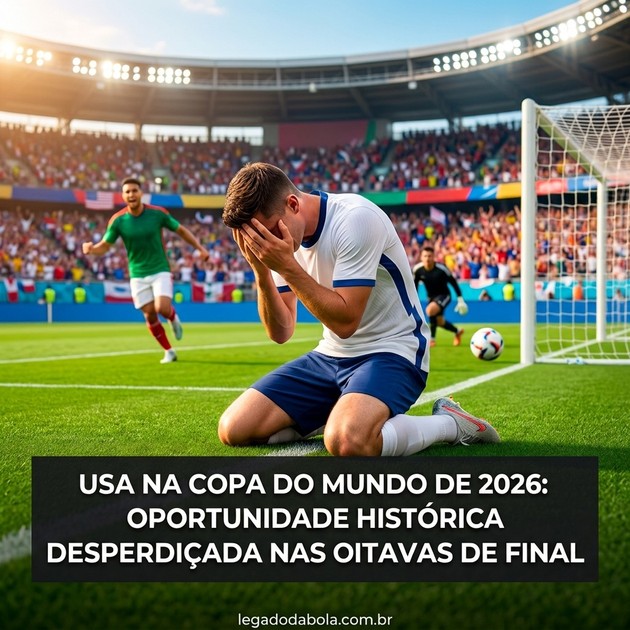
The USA fell in the round of 16 of the 2026 World Cup, repeating the same result from previous editions - even as host nation with a highly favorable draw.
What Happened
The US national team ended their 2026 World Cup campaign in the round of 16. The elimination closes a run that generated enormous expectations, fueled by a favorable group stage draw and the fact that the USA was one of the host nations.
During the group stage, the Americans advanced but without the expected flair. The team did not show the consistent soccer that would justify the hype surrounding them.
In the round of 16, reality hit hard. The opponent proved to be an insurmountable barrier, and the USA once again exited before the quarterfinals. American fans who filled the stadiums and created an incredible atmosphere went home far too early.
The 2026 World Cup was seen as the greatest chance in US soccer history to go deep in a World Cup - with the advantage of playing at home for the first time since 1994.
Impact on the Team and Competition
The round-of-16 exit leaves American soccer in a moment of deep reflection. The MLS grew, investments increased, American players began featuring at top European clubs - and yet competitive results did not follow the development curve.
The impact goes beyond the field. The 2026 World Cup was a massive marketing window for soccer in the USA. A run to the quarterfinals or semifinals would have had an enormous impact on the sport's popularity in the country. Exiting in the round of 16 keeps soccer as a second-tier sport behind baseball, basketball and American football.
For the US Soccer Federation, pressure for structural changes is expected to grow. The question everyone asks: what needs to change for the USA to become a real soccer power, not just a host nation?
The USA had everything going for them in 2026 - the draw, the home crowd, the moment. And still they went home in the round of 16, once again.
Reaction from the Soccer World
The international press reacted with a mix of surprise and understanding. ESPN, which covered the American campaign extensively, highlighted that the team had every condition to go further but simply did not deliver on the field.
The American fanbase, which filled stadiums and created emotional scenes throughout the tournament, expressed frustration. Social media was flooded with questions about the future of soccer in the country and about tactical choices made throughout the cycle.
In the rest of the soccer world, the elimination was seen as confirmation that growing into a powerhouse requires more than infrastructure and money - it requires a deep soccer culture that the USA is still building.
Relevant History
The United States have a curious World Cup history. In 1994, when they hosted the tournament for the first time, they reached the round of 16. In 2002, they produced one of the greatest surprises by reaching the quarterfinals, eliminating Portugal and Mexico along the way.
But since 2002, the American team never repeated that performance. In 2010, they fell in the round of 16. In 2014, same result. They missed the 2018 World Cup entirely - a traumatic episode. They returned in 2022, fell in the round of 16 to the Netherlands. And now in 2026, the same story.
The pattern is clear and concerning: the USA reach the round of 16 and stop. The quarterfinal barrier seems like a glass ceiling that American soccer has not yet managed to break through.
The USA's best World Cup run was in 2002, when they reached the quarterfinals. Since then, they have never repeated the feat - and in 2026 they missed another golden opportunity.
Numbers and Statistics
The data shows a consistent and worrying pattern for American soccer. The US national team has participated in 12 World Cups throughout their history, with results that vary greatly from edition to edition.
The only advancement beyond the round of 16 in the modern era was in 2002, when they reached the quarterfinals. Since then, in four participations (2010, 2014, 2022 and now 2026), they always fell at this same stage - or did not even qualify, as in 2018.
What Comes Next
Now begins the process of analysis and reconstruction. US Soccer will need to evaluate whether the coach stays, which players truly have the level to represent the USA at a higher stage and what needs to change structurally só that the 2030 cycle turns out differently.
The next World Cup will be in 2030, a special edition celebrating 100 years of the tournament. For the USA, it will be four more years to try to build a team capable of going beyond the round of 16 - something that seems simple on paper but has proven enormously difficult in practice.
The current generation - with players like Christian Pulisic, Weston McKennie and others playing at major European clubs - still has time to compete in another World Cup. The question is whether they will be able to make a collective quality leap that did not happen individually in 2026.
Expert Opinion
The problem with the USA is not individual talent. It is collective identity. A country that produced Pulisic, who plays at AC Milan, and others playing in the best European leagues should be able to go beyond the round of 16. But soccer is not made from individual talent alone.
What American soccer lacks is something that cannot be bought or built quickly: a playing culture. Brazil learns soccer in the street. Argentina lives soccer in the neighborhood. In the USA, soccer still competes with five other sports for children's attention. That has a direct consequence on player development.
The 2026 World Cup was the perfect moment for American soccer to prove it was ready for the next level. Playing at home, with a favorable draw and a generation of players formed in Europe - it was now or never. The result shows that despite all the growth, US soccer is still not a true powerhouse. It may be one day. But that day was not in 2026.