Context and importance
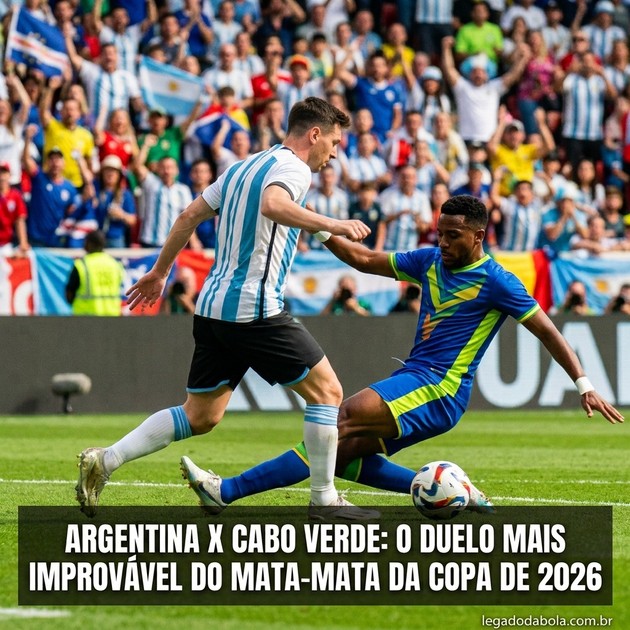
The 2026 World Cup has reached the knockout stage and delivered the most unlikely tie in its recent history: Argentina, the reigning world Champions, against Cape Verde, absolute debutants in the tournament. On one side, Lionel Messi, the greatest player of his generation. On the other, Vozinha, a veteran goalkeeper from an African archipelago of roughly half a million people.
The international press is already calling it the biggest mismatch ever seen in a World Cup knockout tie. The BBC summed up the mood perfectly: it is the battle no-one knew they wanted, but which fans now cannot wait to see.
For supporters, the match carries everything that makes football irresistible. Logic points one way only. The ball, as everyone knows, never signed a contract with logic.
A team with three world titles against a country playing its first World Cup: football has rarely offered such a contrast in a knockout match.
What happened
With the group stage of the 2026 World Cup complete, the knockout bracket put Argentina and Messi face to face with Cape Verde and Vozinha. Both teams secured qualification and now meet in a single-elimination match in the new 48-team World Cup hosted by the United States, Mexico and Canada.
For the Blue Sharks, as the Cape Verdean national team is known, every step at this World Cup is already historic. The country qualified for the tournament for the first time in October 2025 and, on debut, reached the knockout rounds, a rare feat for any newcomer.
Argentina arrive as natural candidates for back-to-back titles. Champions in Qatar in 2022, the Albiceleste defend their crown with Messi, at 39, still the technical and emotional reference of Lionel Scaloni's side.
Cape Verde are playing their first World Cup and have already reached the knockout stage on debut. The team from a nation of half a million people now face the reigning world Champions.
Impact on the teams and the competition
For Cape Verde, reaching the knockouts has already changed the level of the national game. Global visibility, FIFA prize money and growing interest in diaspora players should transform the federation and attract a new generation of talent to the Blue Sharks.
For Argentina, the tie is a classic trap. Winning is an absolute obligation, and any other result would go down as one of the biggest upsets of all time. The pressure, therefore, sits entirely on one side.
For the competition, the tie reignites debate over the 48-team format. Critics point to imbalance, but defenders argue that this is exactly the kind of story world football gains when it opens the door to new countries.
Argentina know the price of underestimating an opponent: in 2022 they lost to Saudi Arabia in their opening match in Qatar before recovering to win the title.
Reaction from the football world
The international press has embraced the tie. The BBC framed the direct duel between Messi and Vozinha as the symbol of the match: the most decorated number 10 in history against a goalkeeper who built his career far from the spotlight and became a national hero.
On social media, fans around the world have adopted Cape Verde as their second team. The David versus Goliath script has turned the Blue Sharks into the neutral fan's favourite at this World Cup, with support growing round by round.
In Brazil, the sympathy runs even deeper. Cape Verde is a Portuguese-speaking country with strong cultural and historical ties to Brazilian football, and a large part of the Brazilian public will happily cheer for the underdog.
The Cape Verdean diaspora around the world is estimated to be larger than the population living on the islands. Many national team players were born or raised in Europe.
Relevant history
World Cups have a tradition of turning imbalance into legend. Cameroon beat Maradona's Argentina in the opening match of 1990, Senegal defeated Champions France in 2002, and Iceland, a country with an even smaller population than Cape Verde, held Messi's Argentina in 2018.
Cape Verdean football has sprung surprises before. In 2013, in their first Africa Cup of Nations, the team reached the quarter-finals and announced to the continent that the archipelago had a real side.
Argentina, for their part, know the weight of these matches. Beyond the historic stumble against Cameroon in 1990, the defeat to Saudi Arabia in 2022 proved that even a world-champion squad is not immune to an inspired underdog.
In 1990, Cameroon beat Argentina 1-0 in the opening match of the World Cup in Italy. It remains one of the greatest upsets in tournament history and a permanent reminder for favourites.
Numbers and statistics
The contrast starts off the pitch. Argentina has around 45 million people and one of the greatest traditions in world football. Cape Verde has a population of roughly half a million spread across an archipelago of ten islands in the Atlantic.
On the pitch, the gap is just as striking. Messi has eight Ballon d'Or awards and was champion and best player of the 2022 World Cup, scoring seven goals in the tournament. Argentina won the World Cups of 1978, 1986 and 2022.
Cape Verde, by contrast, are playing their first World Cup and sit dozens of places below Argentina in the FIFA ranking. No other World Cup knockout tie has ever brought together such different resumes.
What comes next
The winner stays alive in the 2026 knockout bracket and moves closer to the decisive rounds. For Argentina, the match is another step towards back-to-back titles, something no team has achieved since Brazil in 1958 and 1962.
For Cape Verde, the legacy is already secure, whatever happens. But nobody in the Blue Sharks squad came this far to make up the numbers: the chance to knock out the world Champions comes once in a lifetime.
There is also the emotional layer hanging over everything: at 39, all signs suggest Messi is playing his final World Cup. Every match could be his last on this stage, giving each Argentina game the extra weight of a farewell.
Expert opinion
Ties like this are the ultimate test of the World Cup's new format. Those who see only the imbalance forget that the tournament has always lived off these stories: without room for the small, there are no upsets, and without upsets football loses part of its soul.
Argentina win this match in 99 out of 100 scenarios. The problem is that the World Cup has a cruel habit of drawing exactly the missing one. If Vozinha has the afternoon of his life and Cape Verde turn the game into an emotional battle, the favourites will discover that pressure is a currency that only weighs on those with everything to lose.
Tactically, Cape Verde's path is well known: a low block, compact lines and the patience to suffer. Argentina need constant movement to free Messi from double-marking and to stop anxiety from turning possession into sterile sideways passing.
In the end, a duel between the greatest player of the modern era and a veteran goalkeeper carrying half a million people on his back is the kind of script no algorithm would write. It is football in its raw state. And that is why the whole world will stop to watch.