Context and Importance
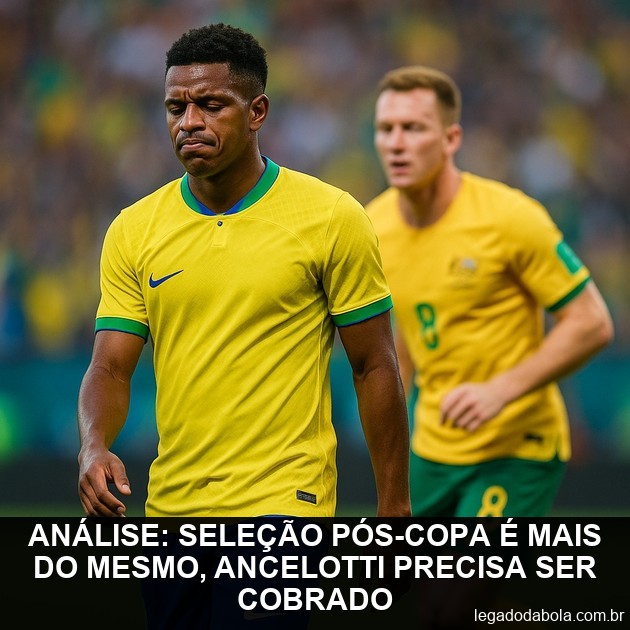
The friendly against Australia should have been a chance to show progress. Instead, it reignited doubts about Carlo Ancelotti's work with the Brazilian national team.
After the elimination at the 2026 World Cup, expectations were for rebuilding. The draw showed the same tactical problems remain, even with a new coaching staff.
This is not an isolated issue. It signals that the root of the problem may not have been addressed with the depth needed after the World Cup failure.
The draw against Australia repeated patterns of play already criticized during the 2026 World Cup.
What Happened
The match against Australia ended in a draw, a result that alone raises questions for a team of Brazil's stature.
More than the score, what stood out was how the Brazilian team struggled to build play and create clear scoring chances throughout the match.
The lack of offensive fluidity, a hallmark of the criticism during the World Cup, appeared again clearly, generating frustration among fans and analysts.
Impact on the National Team
For the Brazilian national team, the moment is delicate. After a disappointing World Cup, the expectation was rapid rebuilding under Ancelotti.
The result against Australia raises a red flag about the pace of that rebuilding. If problems persist in friendlies, concern grows for upcoming official matches.
The lack of collective evolution also affects the squad's confidence. Players carrying the responsibility of rebuilding the team's image feel the extra weight of this tactical stagnation.
A year after the World Cup, Brazil still plays as if nothing has changed.
Reaction from the Football World
The reaction to the draw with Australia was immediate in the sports press. Analyses pointed out that build-up problems remain unsolved.
Fans on social media expressed frustration with the lack of clear tactical identity, demanding more creativity from the team.
Commentators noted that pressure on Ancelotti tends to grow if results don't improve in upcoming matches.
The Gazeta Esportiva analysis summed up the general feeling: the post-World Cup national team seems to be more of the same.
Relevant History
The 2026 World Cup left deep marks on the Brazilian national team. Criticism of the lack of creativity and build-up difficulties was already recurring during the tournament.
Historically, Brazilian football has always been associated with creativity and improvisation. Seeing the national team struggle exactly in those areas is a contrast that bothers fans.
Offensive creation problems were already pointed out as Brazil's main weakness during the 2026 World Cup.
Ancelotti's arrival was seen as an attempt to bring organization and international experience to solve exactly these tactical bottlenecks.
Numbers and Statistics
Although the friendly against Australia doesn't carry extensive statistics, the draw result alone is a relevant data point to measure the team's progress.
The difficulty in creating clear chances throughout the match reinforces the perception that offensive productivity remains the main problem to solve.
These numbers, though limited, serve as a thermometer to assess whether the post-World Cup rebuilding work is actually progressing.
What's Next
Brazil's upcoming matches will be decisive in assessing whether Ancelotti's work has actually evolved.
Every new friendly or official match will now be watched closely, especially regarding offensive creativity and build-up play.
If the problems persist, pressure on the coaching staff tends to intensify, increasing pressure for deeper tactical changes.
Expert Opinion
The draw with Australia shouldn't be treated as an isolated result. It's a symptom of a structural problem the 2026 World Cup had already exposed.
Changing the coaching staff without fixing the root tactical problem tends to produce the same results. That seems to be exactly what's happening with Brazil under Ancelotti.
Ancelotti has pedigree and a winning history, but pedigree alone doesn't solve a collective identity problem. The Brazilian national team needs a clear playing project, not just a big name on the bench.
If fans want to see a competitive Brazilian national team again, the demand for concrete progress needs to start now, before the next cycle also ends in frustration.