Context and Importance
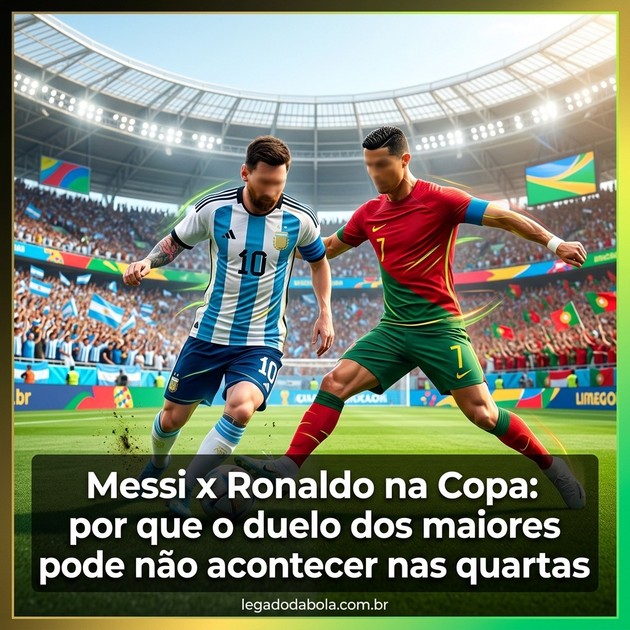
For nearly two decades, football fans around the world have debated one question above all others: Messi or Ronaldo? The 2026 World Cup, hosted across the United States, Canada and Mexico, seemed like the perfect stage for one final chapter in this legendary rivalry. Two icons, potentially facing off in a quarterfinal, with everything on the line.
But football rarely follows the script we write for it. On Saturday, June 28, Portugal drew with Colombia, and that result reshuffled the bracket in a way that left fans across the globe disappointed. The quarterfinal showdown that seemed almost certain is now unlikely - and can only happen, if everything falls into place, in the final itself.
Here at Legado da Bola, we break down what changed, what is still possible and what this means for the greatest individual rivalry in the history of the sport.
Portugal's draw with Colombia placed the Portuguese side in a different bracket half, away from Argentina's path until a potential final.
What Happened
On Saturday, Portugal and Colombia drew at the 2026 World Cup. That result, seemingly just another scoreline, had direct consequences for the tournament bracket. Portugal ended up in a bracket position that avoids a clash with Lionel Messi's Argentina until the final at the earliest.
Before that result, the tournament's math pointed toward a scenario where Portugal and Argentina could meet in the quarterfinals. It was the matchup the entire planet wanted: Cristiano Ronaldo on one side, still with something to prove at a World Cup; Messi on the other, defending the title he won in Qatar in 2022.
With the draw, Portugal moved to the other side of the bracket. The two nations can now only meet if both advance to the final, which requires winning three elimination matches each. The path exists, but it is far longer and more uncertain.
Portugal's draw with Colombia may have taken from the world the last great duel between the two greatest players in recent football history.
Impact on the Competition
Portugal remains alive in the 2026 World Cup and still has a realistic chance of going deep. Cristiano Ronaldo, even in the final stage of his career, remains a key figure for the Portuguese side - and any achievement in this tournament would be the perfect closing chapter to an extraordinary career.
Argentina, meanwhile, still targets a successful title defense. With Messi on the pitch, the Albiceleste are always contenders, and the current bracket still leaves room for both nations to build toward a potential final meeting.
For the World Cup itself, the impact is one of missed opportunity. The tournament has lost - at least for now - the matchup that had been talked about more than any other. It does not diminish the competition, but it removes one of its most emotionally charged possibilities.
Messi and Ronaldo faced each other many times at club level, especially during the El Clasico era between Barcelona and Real Madrid, but they have never met in a World Cup knockout match.
How Football Reacted
The reaction across social media and specialist outlets was immediate. Sports journalists around the world covered the bracket implications of Portugal's draw, with ESPN highlighting the story as one of the most significant of the round. The disappointment of football fans was widely shared.
On social media, supporters from every country commented on what the draw meant. Many pointed out that this could be Cristiano Ronaldo's last World Cup, making the potential meeting with Messi even more loaded with symbolism and nostalgia.
Others noted that football is exactly like this - unpredictably fair. No game is played on paper, and the draw with Colombia was a result earned on the pitch, not a narrative decision. Sport does not exist to serve storylines, but when they emerge naturally, they are irresistible.