
copa-do-mundo

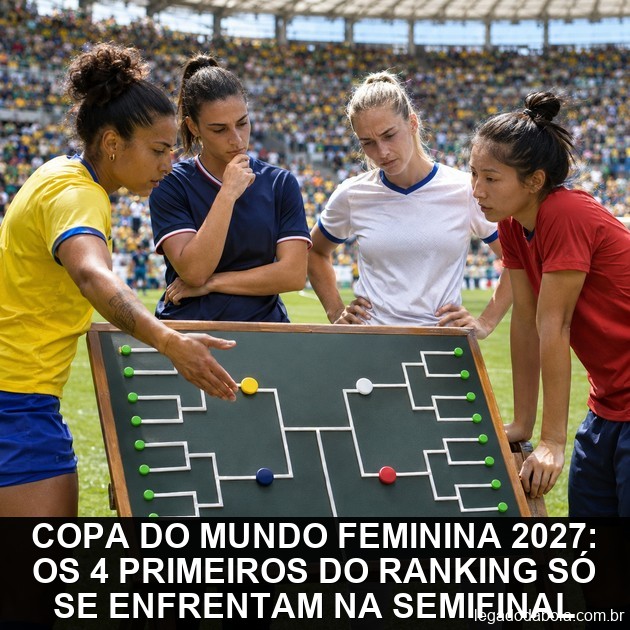
Women's World Cup 2027: Top 4 Ranked Teams Can Only Meet in the Semifinals

If they win their groups, the four highest-ranked teams going into the 2027 Women's World Cup in Brazil cannot meet before the semifinals, according to FIFA.

Women's World Cup 2027: Top 4 Ranked Teams Can Only Meet in the Semifinals
Top 4 separadasSó se cruzam na semifinal, se vencerem os grupos
Copa no BrasilPrimeira edição feminina na América do Sul
Ranking valePosição às vésperas do torneio define a proteção

Context and Importance

The 2027 Women's World Cup will be the first ever played in South America. The tournament takes place in Brazil and is already on the minds of fans, players and coaches.

Now FIFA has detailed how the draw will be run. The core rule: the four highest-ranked teams going into the tournament will not face each other until the semifinals, as long as they win their respective groups.

It sounds like a technicality, but it is not. How the draw works shapes who plays whom, and in the knockout rounds that decides tournaments.

⚽
Highlight

The four best-ranked teams can only meet in the semifinals if they win their groups.

What Happened

FIFA announced a new ruling on how the 2027 Women's World Cup draw will be conducted. The news was reported by ESPN on Wednesday, November 11, 2026.

In practice, the four teams with the best ranking positions ahead of the tournament are placed in separate sections of the bracket. If each finishes first in its own group, their first direct meeting can only happen in the semifinals.

The condition matters: the protection applies to group winners. A team that stumbles in the group stage and finishes second loses that guarantee and may land a tougher path.

Impact on the Competition

For the favorites, the rule works as a reward for consistency. Playing well through the cycle, climbing the ranking and then winning the group secures a path without the biggest rivals in the round of 16 and quarterfinals.

For everyone else, the effect is the opposite. A meeting with a heavyweight becomes likely only in the decisive stage, and the map of the tournament becomes more predictable for those at the top.

There is also a general competitive effect. With the four strongest apart, the tournament tends to reach the semifinals with the big names still alive, which usually boosts the final stretch.

Reaction from the Football World

Draw rules always divide opinion. Supporters of protecting top-ranked teams argue that the ranking should mean something concrete inside the competition.

Others prefer full risk, with heavyweight clashes early and more room for surprises. It is an old debate, present in many national team competitions.

For Brazilian fans, the subject has extra spice. With the World Cup at home, every detail on the road to the final becomes a topic of conversation everywhere.
Relevant History

The Women's World Cup began in 1991 and has had varied Champions. The United States won four times (1991, 1999, 2015 and 2019), Germany won twice (2003 and 2007), and Norway (1995), Japan (2011) and Spain (2023) also lifted the trophy.

📜
History

Brazil's best result at a Women's World Cup is the 2007 runner-up finish, with the generation of Marta.

At the 2023 edition in Australia and New Zealand, the tournament grew to 32 teams. Spain beat England 1-0 in the final and confirmed how much the level of competition has grown.

Numbers and Statistics

The format with 32 teams, eight groups of four and knockouts from the round of 16 is the same as in the previous edition. In a bracket like that, four heavyweights kept apart can only meet in the semifinals.

32Teams at the Women's World Cup
4Top-ranked teams kept apart until the semifinals
2007Year of Brazil's best result (runner-up)

The numbers show why the rule matters. In a tournament with só many strong teams, avoiding an early clash between the top four changes how risk is distributed.

It is worth repeating the key point: the protection depends on winning the group. The ranking opens the door, but performance on the pitch has to confirm it.

What Comes Next

The next step is the draw, which will define the groups and the path of each team. Only after it will the likely knockout matchups become visible.

Until the ball rolls in 2027, the ranking can still change. The position of the top four on the eve of the tournament is what counts for the rule, só friendlies and qualifiers remain important.

For Brazil, the challenge is twofold: perform in front of its own fans and find out where it will sit in the bracket.

Expert Opinion

The rule is fair in intent and healthy for the spectacle. Rewarding the top of the ranking gives value to four years of work, not just to the three or four moments of a draw.

Keeping the four best apart until the semifinals protects the tournament from a clash of giants in the round of 16, but it does not remove surprise: whoever slips in the group loses the shield and pays the price.

Whoever wants the protected path must first win the group.

It remains to be seen how the draw will shape the route of the other teams, including the host. Women's football is growing fast, and Brazil has the chance to make the 2027 World Cup a landmark.

Números da notícia

Competição
Copa do Mundo Feminina 2027
Sede
Brasil
Seleções participantes
32
Regra anunciada
Top 4 do ranking separadas até a semifinal

Frequently Asked Questions

What did FIFA decide about the 2027 Women's World Cup draw?

FIFA ruled that the four highest-ranked teams going into the tournament will not meet until the semifinals, as long as they win their respective groups.

Does the rule apply if a favorite finishes second in its group?

No. The protection applies to group winners. A team finishing second may face one of the big teams before the semifinals.

Where will the 2027 Women's World Cup be played?

In Brazil. It will be the first edition of the tournament held in South America.

Related News